Salary Guide
Fresh Graduate IT Salary in Malaysia 2026: What You'll Actually Earn
Xavier Leong
24 July 2026 · 6 min read
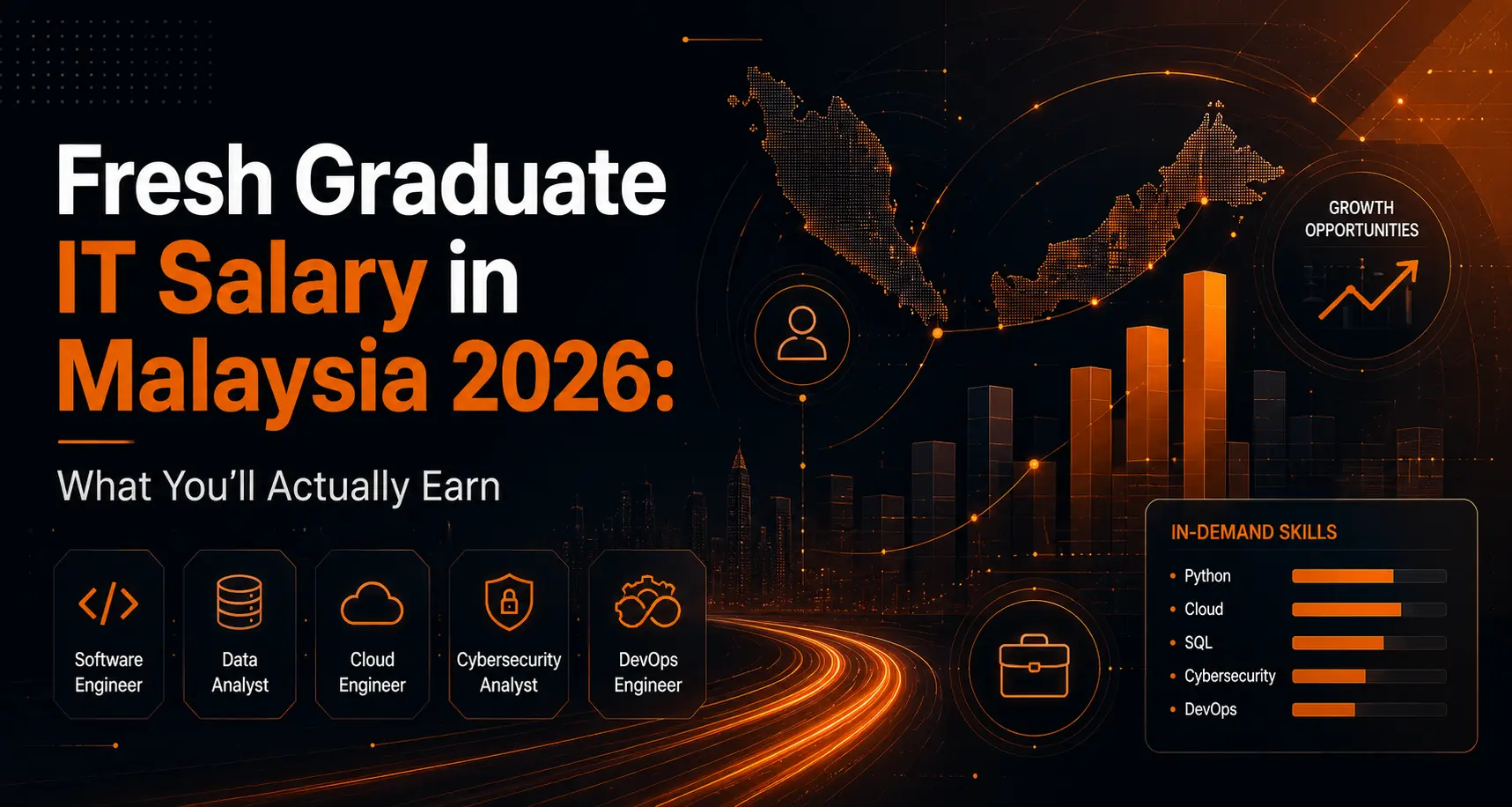
You've probably seen the numbers, and they don't agree with each other. One job listing offers RM2,500. A salary site says RM5,400. Your coursemate swears someone started at RM6,000 in a fintech company. So which is it?
If you're about to graduate, or you're looking at a first offer and wondering whether it's fair, this guide gives you a straight answer. We pulled together the public salary data for entry-level IT roles in Malaysia, checked the sources against each other, and worked out why the figures vary so much, so you can judge your own situation.
The average fresh graduate IT salary in Malaysia
For most fresh IT graduates in Malaysia in 2026, starting salaries land between RM3,000 and RM5,000 a month, depending on the role, your skills, and the type of company you join.
That's higher than the national fresh-graduate average, which sits around RM3,000 across all fields. IT is one of the better-paying places to start for a Malaysian graduate. But the range inside "IT" is wide, and where you land in it depends on choices you can actually influence, which is what most of this guide is about.
Why IT salary figures vary so much
Before the numbers, it helps to understand why you keep seeing figures that contradict each other. Almost all of it comes down to what's being measured.
National median vs sector median. The Department of Statistics (DOSM) puts the Information & Communication sector at a median of around RM4,231 a month. That covers everyone in the sector though, from fresh grads to people with fifteen years in, so it sits well above a true entry-level figure.
Self-reported salary sites. Glassdoor and PayScale rely on users submitting their own pay. Some of their entry-level figures come from just a handful of responses, which makes them shaky. One listing even quoted a "fresh graduate developer" number that turned out to be a mislabelled annual salary.
Role mislabelling. "IT" lumps together jobs that pay very differently. A cloud engineer and a helpdesk technician are both "IT" on paper, but their starting pay isn't close.
Company type. A multinational or a funded fintech pays a fresh grad on a different level from a small local shop. For the same job title, that difference can be RM1,500 a month.
So when a number looks scary-low or too good to be true, the first question is always: measured how, and for whom?
Fresh graduate IT salary by role (2026)
The ranges below are indicative monthly gross salaries in ringgit, pulled from public sources (DOSM, NodeFlair, Glassdoor, PayScale, Talent.com and a few Malaysian graduate-salary reports) and adjusted for how each role tends to sit in the market. The data is strongest for software developers. For the other roles there's less fresh-grad-specific data around, so treat those as sensible benchmarks rather than fixed prices.
| Role | Fresh-grad range (RM/month) |
|---|---|
| Software / Web Developer | 3,000 – 5,000 |
| DevOps / Cloud Engineer | 4,000 – 5,500 |
| Cybersecurity / SOC Analyst | 3,500 – 5,000 |
| Data Analyst | 3,000 – 4,500 |
| QA / Test Engineer | 3,000 – 4,500 |
| IT Support / Helpdesk / Sysadmin | 2,500 – 3,800 |
Software / Web Developer
This is the most common entry point and the one with the most reliable data. Most fresh developers start between RM3,000 and RM5,000, and the top of that band is real if you're joining a fintech or a multinational. What separates a RM3,200 offer from a RM4,800 one is usually a mix of internship experience and a stack the employer needs right now, rather than your CGPA.
DevOps / Cloud Engineer
You'll rarely see "DevOps" as a true fresh-grad title, because most employers want someone who has already touched production. When it does open up to graduates, it pays well, often RM4,000 to RM5,500, and an AWS or Azure certification plus a solid internship is usually what gets you in the door.
Cybersecurity / SOC Analyst
Security roles start around RM3,500 to RM5,000, but almost always with a condition attached. Employers expect either a relevant internship or an entry cert like Security+ or a SOC-focused course. A cybersecurity degree on its own, with nothing practical behind it, tends to land at the lower end.
Data Analyst
Data analyst roles for fresh grads sit around RM3,000 to RM4,500. The lever here is tooling. SQL plus a BI tool like Power BI or Tableau gets you a job; adding some Python and a bit of statistics is what pushes you toward the top of the band and opens the door to data engineering later.
QA / Test Engineer
Manual QA starts around RM3,000. If you can automate, using Selenium, Cypress or Playwright, you move above manual-only pay and closer to RM4,500. QA is also one of the more forgiving entry points for grads who aren't from a pure computer science background.
IT Support / Helpdesk / Sysadmin
This is the lowest starting band, roughly RM2,500 to RM3,800, but it's also the most open. Non-CS graduates and career-switchers often start here, and it's a legitimate route into networking, systems or security if you keep learning while you work.
What decides where you land in the band
Two people with the same degree can start RM1,500 apart. Here's what moves the needle.
Company type. Multinationals, funded startups and fintech firms pay the most. Established local SMEs sit in the middle. Small agencies and non-tech companies hiring "an IT person" pay the least. This is usually the biggest single factor in your first offer.
Location. KL and the Klang Valley carry a premium of roughly 8 to 15 percent over the rest of the country. Penang, especially around the Bayan Lepas tech corridor, and Cyberjaya are strong too. The same title in a smaller town usually pays less, though your cost of living drops with it, so it's not always a worse deal.
Internship experience. A relevant internship is the most dependable way to start at the top of your band instead of the bottom. Employers read it as someone who can contribute sooner, and they pay for that.
Your stack and skills. Skills that are in demand right now (cloud, a modern framework, Python for data, automation for QA) pull offers up. Being a generalist who knows a little of everything pulls them down, because nobody's sure what you'd actually own on day one.
Take-home pay after EPF, SOCSO and EIS
Your gross salary isn't what lands in your account. There are three standard monthly deductions in Malaysia.
EPF (your share) is 11% of your gross, and that's retirement savings that stays yours. SOCSO is a small table-based amount, well under RM20 a month at fresh-grad pay. EIS is smaller again, around RM7 to RM8. Income tax (PCB) is usually close to zero at this income once reliefs kick in, so EPF is the deduction you'll actually notice.
Here's a RM3,500 gross salary worked through:
| Item | Amount |
|---|---|
| Gross salary | RM3,500 |
| EPF (11%) | −RM385 |
| SOCSO + EIS | −RM25 |
| PCB (income tax) | ~RM0 |
| Take-home | ~RM3,090 |
The RM385 isn't gone, it's your own savings, and your employer adds another 13% on top of that. But when you're budgeting your first year, plan around the take-home figure, not the gross on the offer letter.
How to negotiate your first IT offer
Find your band above and see where the offer sits. Inside the band is fair. Below it is worth a polite conversation.
Weigh the company type before you react to the number. RM3,000 from a small local firm and RM3,000 from a multinational aren't the same deal once you count training, benefits and what the name does for your CV two years from now.
Look past base salary too. Bonus, often one to three months, medical coverage, hybrid flexibility and real learning all carry value, and in a first job that learning compounds faster than a small pay bump.
If you do negotiate, lead with evidence instead of need. Something like "based on market rates for this role and my internship experience, I was hoping for RMx" lands far better than "I need more." Ask once, stay polite, and be ready to hear their reasoning.
One last thing worth keeping in mind: a first salary matters less than most people fear. The steepest pay jumps in a tech career come in years three to five, when you move from executing tasks to owning them. Getting into a place where you'll learn quickly usually beats an extra RM300 at the start.
Fresh graduate IT salary FAQ
How much do fresh graduates earn in IT in Malaysia?
Most fresh IT graduates in Malaysia earn between RM3,000 and RM5,000 a month gross in 2026. The exact figure depends on the role, your skills, and whether you join a multinational, a local SME or a startup.
What is the take-home pay on a RM3,500 IT salary?
Around RM3,090 a month. From a RM3,500 gross salary you lose about RM385 to EPF (11%) and roughly RM25 to SOCSO and EIS combined. Income tax is close to zero at this level once reliefs are applied.
Which entry-level IT role pays the most?
DevOps/Cloud and Cybersecurity tend to pay the most at entry level, often RM4,000 to RM5,500. Both usually expect an internship or a certification, so they're harder to walk straight into as a fresh grad than a general developer role.
Do fresh grads need experience to get an IT job in Malaysia?
Not formal work experience, but an internship makes a big difference to both your chances and your starting pay. Personal projects, a GitHub profile, or a certification can stand in for it, especially for developer and data roles.
Is an IT degree worth it in Malaysia?
For pay, yes. IT starts above the national fresh-grad average and has some of the steepest early-career salary growth of any field. That said, employers increasingly care more about demonstrable skills and projects than the degree itself, so what you build during your studies matters as much as the paper.
How do I know if my first offer is fair?
Compare it against the band for your specific role above, then adjust for company type and location. If it sits inside the range, it's fair. If it's below and you have an internship or in-demand skills, you have grounds to negotiate.
Where to find real IT roles in Malaysia
Benchmarks tell you what to expect. The next step is seeing what's actually on offer.
TechireX is a Malaysian IT hiring platform built around tech roles only, from software and data to cloud and security, across KL, Selangor, Penang and remote. You can browse current openings at techirex.com, and follow our Telegram channel to catch new IT jobs as they go up.
Figures here are benchmarks pulled from public sources (DOSM, NodeFlair, Glassdoor, PayScale, Talent.com and Malaysian graduate-salary reports) as of 2026. They're a market reference, not a guarantee. Real offers vary by employer, location, skills and how you negotiate.