Interview Prep
How to Prepare for an IT Job Interview in Malaysia: 2026 Guide
Xavier Leong
8 August 2026 · 10 min read
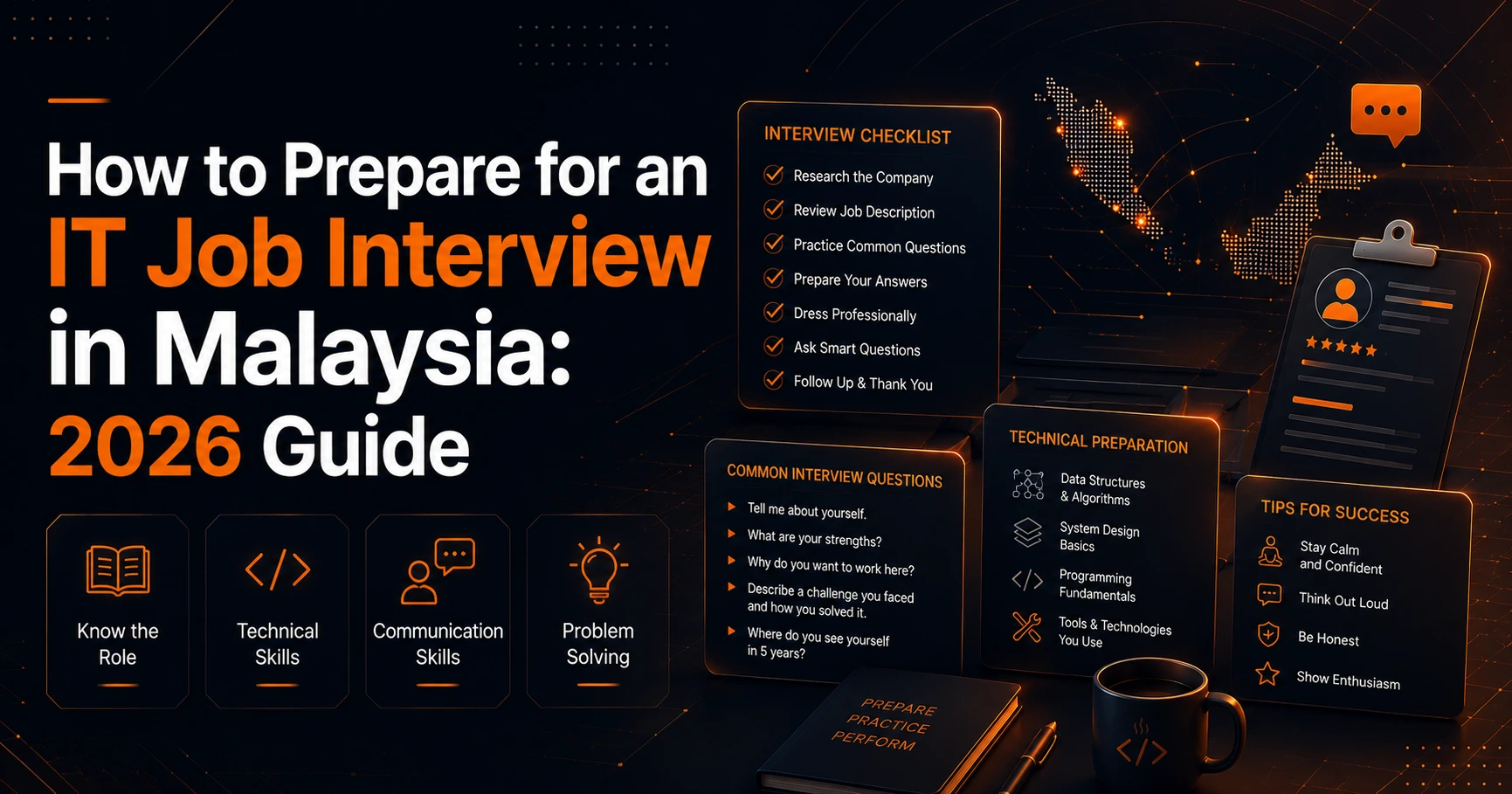
Most tech interview guides online are written for someone chasing a job at Google or Amazon, all LeetCode grinding and whiteboard system design. That's useful if you're aiming at Silicon Valley. But if you're interviewing for an IT role at a Malaysian company, a GBS centre, or a local fintech, the process looks different, and preparing for the wrong thing wastes your energy.
This guide covers how IT interviews actually work in Malaysia in 2026: the rounds you'll go through, the questions you'll face with real example answers you can adapt, the online assessments that keep catching people out, and the local etiquette that quietly makes a difference. Whether it's your first interview or your fifth, this is what to focus on.
Understand the Malaysian IT interview process
Malaysian employers, especially larger ones, usually run several rounds, and each one is testing something different. Preparing for all of them as if they're the same is a common mistake. Here's what to expect.
First round: HR or recruiter screen
This is usually a phone or video call that confirms your background, your motivation, how you communicate, and your salary expectations. It's rarely deeply technical. The goal here is to come across as clear, positive and genuinely interested, and to have a sensible salary range ready when they ask, because they usually will.
Second round: hiring manager
This is where it gets real. The hiring manager goes deeper into your skills and how you'd actually perform in the role. Expect role-specific questions, technical discussion, and sometimes a coding exercise, take-home assignment or case question. Bring concrete examples of things you've built or fixed, not just descriptions of what you know.
Final round: senior leadership or culture fit
Not every process has this, but larger companies often do. This round is frequently less about technical depth and more about values, culture fit, and whether they can see you growing with the company. It's also your clearest chance to ask thoughtful questions about the team and the direction of the work.
Before the interview: research and preparation
Preparation is what turns a shortlist into an offer, and most of it happens before you're in the room.
Research the company properly. Understand what they build, who their customers are, and where they sit in the market. If they're a managed IT services firm or a fintech, get familiar with that space specifically. Being able to reference something concrete about the company signals real interest, and it's rarer than you'd think.
Re-read the job description. Pull out the key skills and technologies they list, and be ready to speak to each one with an example. If they mention a stack you're weak in, prepare an honest answer that shows you can learn fast rather than pretending.
Prepare your questions. Have a few ready to ask them. Tailor at least one to something specific about the company. Avoid leading with questions purely about salary, leave or working hours in an early round; those are better raised once there's mutual interest or at the offer stage.
Technical interview preparation
Here's where the international guides oversell it. Unless you're specifically targeting a FAANG company or a top-tier product firm, you usually don't need to grind hundreds of LeetCode problems. Most Malaysian IT employers want to see solid fundamentals and evidence you can actually do the job, not competitive-programming speed.
What to focus on depends on your role. A developer should be comfortable with core data structures, basic algorithms, and the language and framework in the job description, and be ready to talk through code they've written. A data analyst should expect SQL questions and be able to reason about data, plus some Python or a BI tool. An IT support or infrastructure candidate should brush up on networking basics, operating systems, and troubleshooting scenarios. Match your prep to the actual role, not to a generic "tech interview."
Whatever the role, two things always help. Be ready to walk through your own projects: what the problem was, the decisions you made, and what you'd do differently now. This is the strongest technical signal for most local roles. And if there's a coding exercise, think out loud: restate the problem, ask clarifying questions, explain your approach before you write code, and mention trade-offs. Interviewers are assessing how you think, not just whether you reach the answer.
Common interview questions and how to answer them
Most interview questions, technical or behavioural, can be answered with a short, structured story. The mistake people make is rambling. Below are the questions you'll almost certainly face, with example answers you can adapt to your own experience.
"Tell me about yourself"
They don't want your life story. Give a tight 60 to 90 second summary: who you are professionally, a strength or two backed by evidence, and why you're excited about this role. A simple structure that works: present, then past, then why this job.
Example answer:
"I'm a fresh Computer Science graduate from UM, and I've spent the last year focused on backend development. During my final-year project I built a REST API for a campus event system using Node.js and PostgreSQL, which taught me a lot about database design under real constraints. I also did a four-month internship at a local fintech where I worked on their payments backend. I'm drawn to this role because it's backend-heavy and your team works on payment infrastructure, which is exactly the area I want to grow in."
Notice it's specific (real tools, real projects), it's short, and it ends by connecting the candidate to this role. Swap in your own details and keep that shape.
Behavioural questions: use the STAR method
Behavioural questions ("tell me about a time you...") are best answered with STAR: Situation (the context), Task (what needed doing), Action (what you specifically did), Result (the outcome). Prepare five or six of these stories in advance, covering different scenarios, and practise telling each in under two minutes.
Here's the difference it makes. A common question is "tell me about a time you solved a difficult technical problem."
Weak answer:
"There was a bug in our project and it was really hard, but I worked on it for a long time and eventually fixed it. It was a good learning experience."
Strong answer, using STAR:
Situation: "During my internship, our web app started timing out for users during peak hours, and customers were complaining."
Task: "I was asked to find the cause and fix it before the next release, within about three days."
Action: "I profiled the slow requests and traced it to a database query running inside a loop, making hundreds of calls per page load. I rewrote it into a single query with a join and added an index on the column we were filtering on."
Result: "Page load time dropped from around eight seconds to under one, and the timeout complaints stopped. I also documented the fix so the team could spot the same pattern elsewhere."
The strong answer isn't longer because it's padded, it's longer because it's specific: a real cause, a real action, a measurable result. That's what interviewers remember.
"What is your greatest weakness?"
Pick a real weakness, then show what you're doing about it. The improvement is the whole point; a fake weakness ("I work too hard") is transparent and every interviewer has heard it.
Example answer:
"Early on I tended to jump straight into coding before fully understanding the requirements, which sometimes meant reworking things later. I've been consciously fixing this by writing out the problem and edge cases before I start, and asking clarifying questions upfront. It's slowed my start but saved a lot of rework, and my code reviews have gotten noticeably cleaner."
"Why do you want to work here?"
This is where company research pays off. Connect something specific about the company to something specific about you. Avoid generic praise like "you're a great company"; that could apply to anyone and signals you didn't prepare.
Example answer:
"I've been following how your team is building out your cloud infrastructure, and I noticed you're moving toward a microservices setup. I've been learning Docker and AWS on my own projects, and the chance to work on that kind of architecture in a real production environment is exactly what I'm looking for at this stage of my career."
Handling the salary question
The HR round often asks your salary expectation, and freezing here costs people money. Know the market rate for the role before you walk in, and give a confident range rather than a single number or an "I'm flexible."
Example answer:
"Based on the market rate for this role and my internship experience, I'm looking at somewhere in the range of RMx to RMy, but I'm open to discussing the full package."
To set that range with real figures, check what the role actually pays before the interview. Our fresh graduate IT salary guide breaks down starting pay by role so you can walk in with a number you can defend.
Don't overlook online assessments
This one catches people out. Increasingly, Malaysian employers add an online assessment before or alongside the interview, and some candidates treat it casually and get filtered out before they ever speak to a human.
These usually take one of a few forms: an aptitude test (numerical, logical and verbal reasoning under time pressure), a personality profile, or a technical test such as a timed coding challenge on a platform like HackerRank or a take-home assignment. Practise the aptitude format beforehand so it doesn't surprise you, do it in a quiet space with a stable connection, and don't rush. Passing the assessment is often what gets you the actual interview.
Interview day: etiquette in Malaysia
The local basics matter, and getting them right removes any easy reason to mark you down.
Dress smart. Business casual is generally safe in Malaysia's IT industry. Neat and professional beats overdressed or too casual. When unsure, lean slightly more formal for a first interview.
Arrive early. Aim to be there 10 to 15 minutes before your scheduled time. For a video interview, log in a few minutes early and check your camera, mic and connection beforehand.
Communicate clearly. Speak in clear, concise language. Avoid heavy jargon unless you're sure the interviewer shares it. Being understood matters more than sounding clever.
After the interview: follow up
Here's a small move that punches above its weight in Malaysia: send a short thank-you message after the interview. It's still uncommon here, which is exactly why it works. A brief, genuine note thanking them for their time and reaffirming your interest quietly sets you apart from candidates who don't bother.
Keep it short, send it within a day, and reference something specific from the conversation so it doesn't read like a template.
IT interview preparation FAQ
How do I prepare for an IT interview in Malaysia?
Start by understanding the multi-round process most Malaysian employers use, research the company and role thoroughly, prepare five or six STAR stories for behavioural questions, brush up on the fundamentals your role needs, and practise any online assessment format in advance. Begin preparing at least a week or two before the interview.
Do I need to grind LeetCode for IT jobs in Malaysia?
Usually not to the extent international guides suggest. Heavy algorithm practice mainly matters for FAANG-style companies and top product firms. Most Malaysian employers care more about solid fundamentals and your ability to explain real projects than competitive-programming speed.
What questions are asked in a Malaysian IT interview?
Expect a mix of behavioural questions (tell me about yourself, a challenge you solved, your weaknesses), role-specific technical questions, and sometimes a coding exercise or case question. The HR round also typically asks about your motivation and salary expectations.
What should I wear to an IT interview in Malaysia?
Business casual is generally safe in Malaysia's IT industry. Aim to look neat and professional, and lean slightly more formal for a first interview if you're unsure.
How many interview rounds are typical in Malaysia?
Larger employers often run two to three rounds: an HR or recruiter screen, a hiring manager round that goes deeper on skills, and sometimes a final round with senior leadership focused on culture fit. Smaller companies may have just one or two.
Should I send a thank-you message after an interview?
Yes. A short, genuine thank-you note within a day of the interview is still uncommon in Malaysia, which makes it an easy way to stand out and reaffirm your interest.
Where to find IT jobs in Malaysia
Preparation only pays off when you're interviewing for the right roles. TechireX is a Malaysian IT hiring platform focused on tech roles only, from software and data to cloud and security, across KL, Selangor, Penang and remote. Browse current openings at techirex.com, and follow our Telegram channel to catch new IT roles as they go up.